 14 DAY TRIAL //
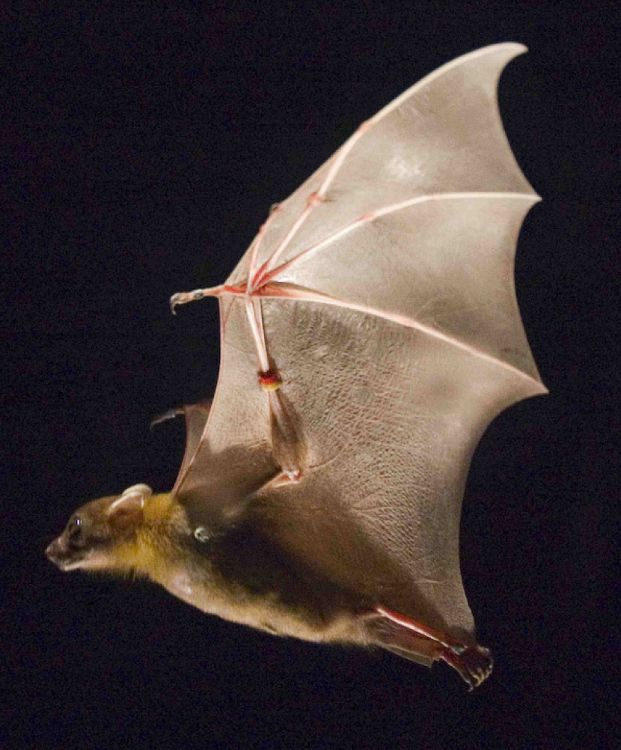
 Bats have apparently evolved to take advantage of the numerous bones and joints in their hand-like wings. A new study shows that the creatures are able to save a great amount of inertial energy during upstrokes, by folding their wings in a specific manner.
The only reason why they are able to do this is because their wings are very flexible. Scientists say that the new finding should be of great use for flight engineers currently researching flapping wing designs for aircraft. The work suggests a folding design is the most efficient way to move forward.
Another thing that engineers will have to keep in mind is the mass of the actual wing. In bats, the thin membranes that allow them to fly also keep their overall weight very low. The new study was led by an interdisciplinary team of biologists, physicists, and engineers at Brown University.
By analyzing bat flight dynamics in great detail, scientists were able to figure out that the creatures fold their wings inward to their bodies in order to save up to 65 percent of the inertial energy that would otherwise be required for an upstroke.
This means that they save 35 percent of the energy budget that needs to be expanded if they want to fly with their wings continuously outstretched. This is very important since bats have muscular wings that also feature bendable joints like the ones found in a human hand.
Brown scientists believe that this type of wing flexibility appeared in order to allow the creatures to compensate for the extra weight.“Wing mass is important and it’s normally not considered in flight,” scientist Attila Bergou explains.
“Typically you analyze lift, drag, and you don’t talk about the energy of moving the wings” says the expert, a co-leader of the new investigation, alongside colleague Daniel Riskin. Their study was published in the April 11 issue of the esteemed scientific journal Proceedings of the Royal Society B.
The investigation was supported by funds from the US Air Force Office of Sponsored Research. The USAF is very interested in developing small, light, flapping vehicles, capable of gathering intelligence and surveillance data over a given territory.
“Retracting your wings has an inertial cost. It is significant but it is outweighed by the savings on the up and down stroke,” Bergou concludes.