 14 DAY TRIAL //
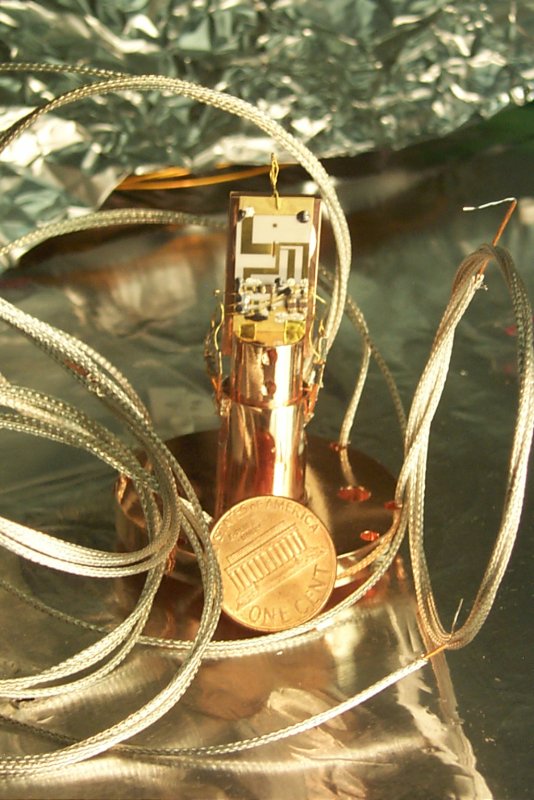
 National Institute for Standards and Technology researchers remain at the spearhead of atomic clocks design by creating what is known to be the most accurate time keeping device in the world. In 2004 NIST further enhanced atomic clocks by creating one on a chip a hundred times smaller than the previous atomic clock design. The newly developed device is accurate to one part in 10-17, basically introducing an error of plus/minus one second once a billion years.
Atomic clocks and optical clocks in special are well known for their time keeping capabilities, since they work by measuring certain oscillations originating inside atoms. Atomic clocks, for example, rely on microwave radiation, while optical clocks, as their name suggests, make use of laser beams of light in the optical wavelengths of the electromagnetic spectrum to excite atoms into an ion state.
Anyway, before this happens, one more thing must be accounted for. The laser beam must emit light in a certain wavelength, otherwise the atom cannot absorb the energy it is provided with to shift to an ion state. By absorbing a photon with the specific wavelength and energy, an ion may shift from one particular energy level to the superior one, and then the system instability should immediately re-emit the photon in order to regain stability. To give you an idea about the frequencies one ion is oscillating at inside an atomic clock, one should probably know that the cesium-133 atom completes 9,192,631,770 such cycles within a second - this also being the definition for the second.
But cesium-133 is not the only chemical element that can be used to create atomic clocks. Mercury, for example, is much more accurate at time keeping, albeit it is extremely sensitive to changes in temperature and electric field. According to Till Rosenband of NIST, aluminum would be a much better choice since it is not as sensitive as mercury, but this also means it is hard to probe directly with optical light. To solve this 'little' problem, Rosenband thought about transferring the transition state of aluminum ions to beryllium ions placed close to an aluminum ion trap, thus enabling indirect measurement of the oscillating frequency with the help of optical light.
But what can we do with such a accurate time keeping device? GPS satellites would be one application for the aluminum optical clock to allow tracking capabilities with an accuracy of less than one meter, but it could have much more relevant significance in physical experiments such as measuring the fine-structure constant which governs the universe to determine whether it has changed over time.
During the experiments, the NIST researchers found that the fine-structure constant varies within 1.6 x 10⁻¹⁷ per year, which is inconclusive while trying to determine whether it is actually changing. With an accuracy of 1 part in a billionth of a billionth of a second, the aluminum optical clock is currently the most accurate clock in the world, a capability which physicists plan to exploit to the maximum in order to make further measurements on the fine-structure constant.