 14 DAY TRIAL //
 1. Skunks appeared 40 million years ago, evolving from common ancestors with the weasels and polecats (no doubt about the last ones...). They evolved only in the Americas, where they are still found today, from Southern Canada to the southern tip of South America.
The oldest skunk fossils are 10 million years old (the end of the Miocene): Pliogale and Martinogale encountered in Kansas. Today, 3 genera are known, all being over 2 million years old (from Pliocene): stripped skunks (Mephitis), spotted skunks (Spilogale) and hog-nosed skunks (Conepatus). All live in North and Central America. Hog nosed skunks are the only ones found also in South America.
Skunks vary in weight from 0.2 kg (0.5 pounds) in spotted skunks to 5 kg (11 pounds) in hog nosed skunks, while the length can be 40-68 cm (1.3-2.3 ft), depending on the species.
2. Skunks are rather peaceful animals. Till one point, they prefer not to waste their famous chemical weapon. The stinky secretion is produced by a pair anal glands. All weasel related animals have them, being employed mainly for marking the territory.
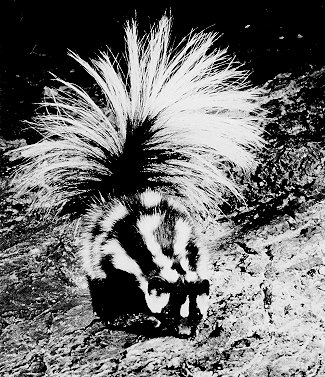
That's why they have an elaborated warning behavior: they curb their tail over the back, stomp, show off their teeth, grunt, puff, curb their back, beat the ground with their limbs and execute their famous stunt walking on their fore limbs. This means an imminent shot is coming! If not enough, with the head and tail forward, and the arched back, and gushes precisely the liquid towards the enemy.
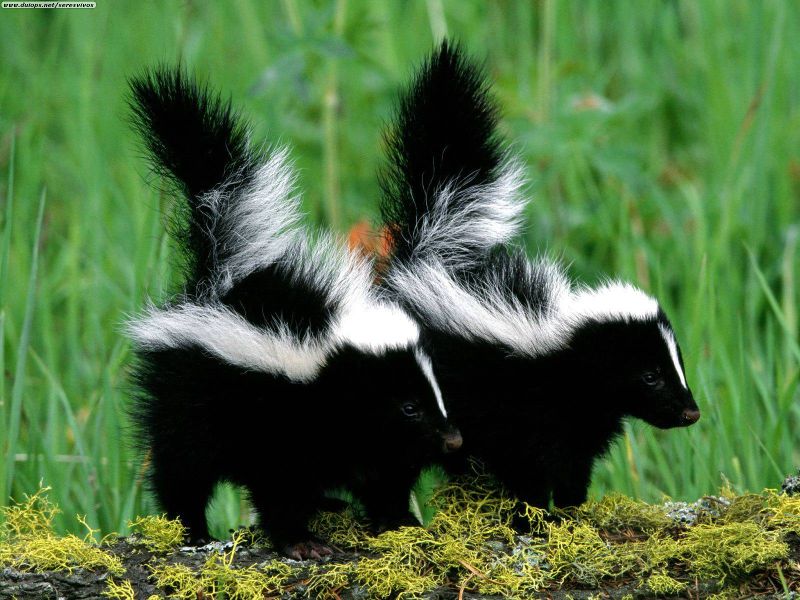
The stinky liquid can be shot up to 5 m (16 ft) away with high precision towards a menacing person or animal. The skunk can send 3-6 jets of oily liquid at once (15 cubic centimeters), and the refilling of the reservoir takes up to 10 days. The color pattern of the skunks has also the role of warning, so that the animal does not have the waste its precious liquid.
Just one shot is enough to induce intense pain or temporary blindness if it touches the eyes. The smell can be felt from a distance of 2.5 km (1.6 mi) in windy conditions. The secretion has the role of deterring predators, and for the human face and eyes is a powerful irritant. The secretion contains a mix of sulfur-containing chemicals (methyl and butyl thiols) inducing a highly offensive smell of rotten eggs, garlic and burnt rubber. The smell is so powerful that chases away bears and causes nausea in dogs. It can be hard to get rid of it from clothing, but tomato juice, hydrogen peroxide or sulfurated alcohol can be employed in this purpose.
Still, big owls and eagles (most birds have extremely weak smell) are not affected by the secretion, and skunks are also preyed by foxes, coyotes, lynxes, pumas, and badgers. Skunks are also hunted for their fur.
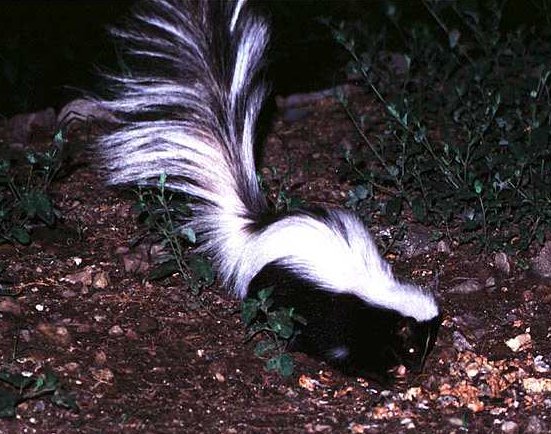
3. Skunks are nocturnal, solitary and territorial. They live in forests, farms, grasslands, deserts, rocky areas with bushes and suburban areas. These mammals wander 0.4-0.8 km (0.25-0.5 mi) per night in search of food (females less than males), but when looking for sex, the male can roam 2.5 km (1.6 mi) per night. Skunks leave their dens by about 18:00-19:00 in the evening and return by 6:00 in dawn. During chili winter nights they go out less than 4 hours, and if the winter is tough, they can remain in their dens for days.
In northern areas, skunks pass through a winter sleep (not a real hibernation) similar to that of the bears, and which can last 75-100 days.
Skunks stay in their dens (burrows) during the day. The den is dug by another animal (armadillo, fox, badger, marmots), and they can install even in the basements of the houses and caves. Skunks rarely dig by themselves their dens. The den has a resting room folded with dry vegetation, and when the temperature drops, the chamber is closed with vegetation. Sometimes, several skunks inhabit the same den, and sometimes they share the den with a fox or a raccoon. Spotted skunks can also shelter in tree hollows.
Males have territories of 6-11 square kilometers, overlapping those of several females. The maximum density is of 8.8 skunks per square kilometer.
4.Skunks eat earthworms, insects, snails, spiders, rodents, shrews, frogs, lizards, snakes (they are immune to rattlesnake venom, being unaffected by doses 100 higher than those killing a dog), occasionally rabbits, eggs and cadavers. In the summer-autumn, they also eat wild fruits, berries, grass, leaves, but the animal food forms 60-90 % of the total.
Hog nosed skunks are rather insectivorous, their bare, wide and prolonged snout being an adaptation for digging in search of insects.
Skunks visit their feces to eat the feces-consuming insects. They attack bee hives without being annoyed by the stinging, and even eat bees, whose stings are removed by rolling the insects on the ground. Eggs are broken against a tough objects, the way African mongooses do it.
5.The skunks have a penis bone 2.3 cm long. Skunks mate in September-October, but the fecundated egg starts its development in February to April. The proper gestation lasts 42-62 days and the females give birth to 3-10 offspring in April-June. At birth, the offspring are blind and open their eyes when 3-4 weeks old, period during which they get their adult coloration. When 5 weeks old, the offspring start exploring the world, and when 6-7 weeks old, at night, the family forage walking in line. At each 2-3 days, the female changes the den, because the accumulating smell can attract predators. The young can produce and gush the stinky liquid by the age of 5 weeks and are weaned at 8-10 weeks, turning sexually mature by the age of 4 months. The young split off from the mother by the autumn, and breed by the age of one year.
6.Naphtaline grains impede skunks entering the houses, as they are chased away by the camphor scent.