 14 DAY TRIAL //
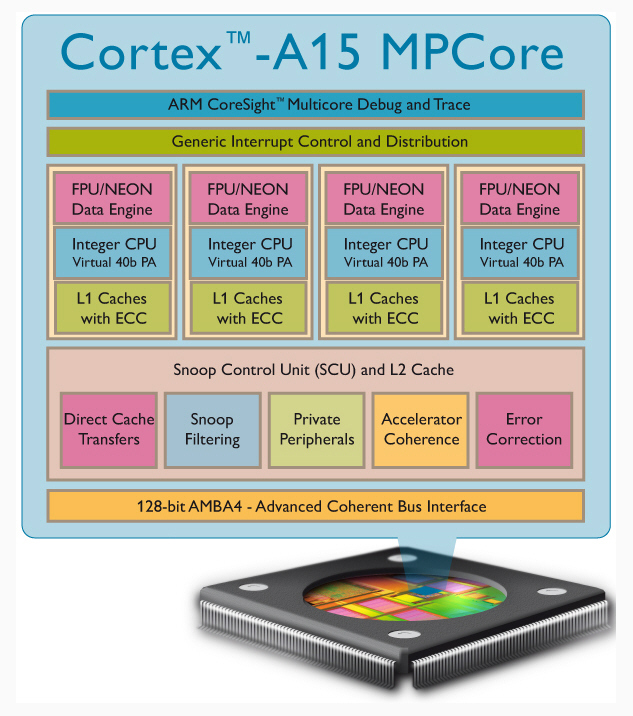
 After the success it enjoyed with the dual core Cortex A15 designs, ARM is announcing today the Cortex-A15 quad core design on its official blog.
The introduction of highly efficient CPU designs based on the Cortex A15 architecture caught everybody by surprise. The surprise wasn’t in the fact that the CPU was more advanced or better performing, but in the level of performance it was able to attain.
A dual core Cortex A15 design is generally just as fast, if not faster than a quad core Cortex A9 without having the downside of requiring a highly multi-threaded application, specially optimized, to show its full potential.
Using a dual core Cortex-A15 will yield much better results than a quad core Cortex A9, especially in single threaded or dual threaded applications that represent more than 90% of the mobile applications in the market right now.
Rarely do we get the chance of a twofold performance improvement from a generation to the next, while keeping the power usage in check.
Well, if a dual core Cortex-A15 is roughly equal, if not faster than a quad core Cortex A9 at its peak performance, a quad core Cortex A15 will double that performance while staying within the power consumption characteristic of the Cortex A9 hard macro.
With the addition of the Cortex A15 MP4 hard macro, ARM delivers three significant firsts in its portfolio.
The Quad Core A15 is ARM’s first 28 nm design and first quad core hard macro and the first hard macro based on the highest performance ARMv7 architecture.
The configuration of ARM’s quad core Cortex –A15 MP4 hard macro includes two 32 KB Level 1 caches with ECC support with single bit parity for Level 1 Instruction Cache. It has 2 MB of Level 2 cache complete with ECC, NEON floating point units, 224 interrupts and 6 power domains.
The working frequency is 2 GHz and the performance is higher than 20,000 DMIPS.