
Softpedia
 

NEWS CATEGORIES:


NEWS ARCHIVE >>
SOFTPEDIA REVIEWS >>
MEET THE EDITORS >>
TRENDING TODAY
Home > News > Technology and Gadgets > Laptops

July 23rd, 2012, 08:31 GMT · By

AMD’s Trinity – Best Mobile Solution for Counter-Strike: Global Offensive

SHARE:

Adjust text size:

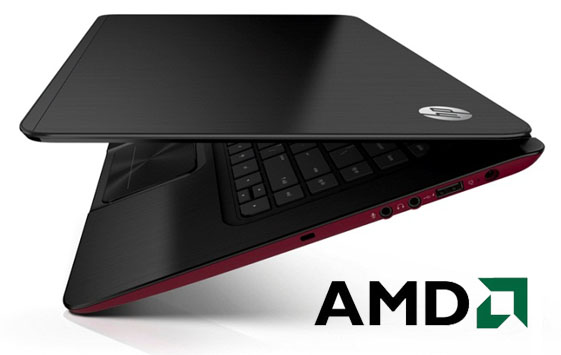
HP SleekBook Powered by AMD's Trinity APU
Enlarge picture
The question of “good enough” performance has been on Intel and AMD’s mind for quite a while. Testing Intel’s reference UltraBook against AMD’s Trinity A10-4600M notebook shows that Intel’s solution is simply not good enough.

Everybody was surprised by Rory Read’s statement that today we have enough CPU power and that companies should start working on improving their GPU performance in their products.

The thing is that Intel is actually doing the same.

Sure, the company has the x86 compute performance superiority, but they’re obviously not concentrating on offering their most powerful CPUs in UltraBooks.

Intel’s priorities in UltraBooks are low power consumption, good system reaction times (and SSDs are responsible for that), low weight and a slim body.

Even future plans don’t relate to CPU processing power at all, as Intel is talking about slimmer HDDs, high-resolution screens and longer battery life.

So, while not stating it openly, Intel acknowledges that CPU power is quite satisfactory nowadays and AMD definitely has to agree, as they have trouble in competing on the x86 side.

Once that’s clarified, hardware experts at vr-zone.com, thinking at casual gamers or at gamers that can’t stay away from their favorite titles even when they are on the road, have decided to do a quick session of Counter-Strike: Global Offensive benchmarking session.

Valve’s new title is going to hit the stores next month and we just had to know whether Intel’s popular UltraBook is up to the challenge.

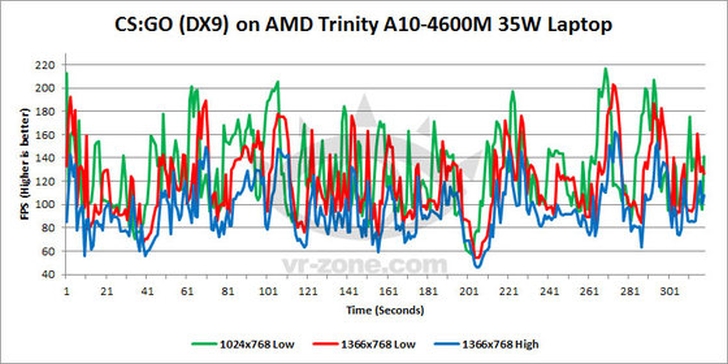
While we don’t have some clear average FPS results on hand, we can clearly see that while AMD’s Trinity only dips well below 60 FPS once, Intel’s UltraBook experiences six or seven times FPS levels lower than 40.

On the upper side of the graph we can see that AMD’s Trinity is able to reach more than 200 FPS in five instances, while Intel’s UltraBook can only reach 150 FPS twice.

So, both platforms can definitely play the game, but AMD’s APU is simply the better choice for Valve’s Counter-Strike: Global Offensive.
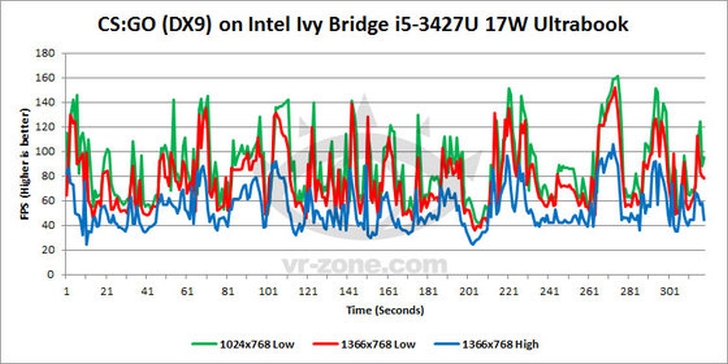
Intel's UltraBook perfromance in Valve’s Counter-Strike: Global Offensive
Enlarge picture
AMD's Trinity perfromance in Valve’s Counter-Strike: Global Offensive
Enlarge picture

FILED UNDER:
intel
ultrabook
amd
trinity
apu


2,089 hits · 3 comments
Link to this article · Print article · Send to friend

MUST-READ RELATED ARTICLES:


LG Shows Cinema 3D IPS Monitors

Gigabyte Launches AMD Radeon HD 7970 GHz Edition Graphics Card

Galaxy Launches Pre-Overclocked GeForce GT 640 2GB Video Card

SilverStone Intros HE01 300W Tower Super Cooler

TSMC to Start Risk 20nm Manufacturing Next Year

READER COMMENTS:


Comment #1 by: sam on 23 Jul 2012, 09:16 UTC reply to this comment

how can one compare a 35W processor (normal laptop) to a ultrabook. Compare i3/i5/i7 ULV to A10 4655M. Of course the latter looses hands down to ULV i3 but cause it cost 1/2 price.

Comment #1.1 by: Constantin Murariu on 23 Jul 2012, 09:38 GMT

The guys said that the comparison is not an apples-to-apples one. The question is what kind of performance the customer should expect if he goes Intel UltraBook or AMD UltraThin.

So, go for AMD and carry 500 grams more, but enjoy the 3D performance or go for Intel UltraBook and enjoy the lighter notebook.

And all this when we compare similarly prices mobile systems.

IF we dwell into systems with the same power consumption, AMD wold be hundreds of dollars cheaper and the budget is probably the most important issue for most notebook buyers.

Bottom line, they're comparing two mobile systems and show how they behave in CS:GO.

P.S. Remember that lower prices Ivy Bridge or Sandy Bridge processors have HD 2500 graphs that is much worse than HD 4000 inside top Ivy Bridge mobile parts.


Comment #2 by: Qemix on 23 Jul 2012, 17:34 UTC reply to this comment

It's comparing the two CPUs because the the A10 is found in UltraThins/Sleekbooks, which is a direct comparison to what Intel offers in their Ultrabooks. This is mainly a comparison of notebook TYPES...If you're in the market for an Ultrabook (Intel) /Sleekbook (AMD), then THIS is what you can expect.

Copyright © 2001-2013 Softpedia. Contact/Tip us at

WindowsGamesDriversMacLinuxScriptsMobileHandheldNews

SUBMIT PROGRAM   |   ADVERTISE   |   GET HELP   |   SEND US FEEDBACK   |   RSS FEEDS   |   UPDATE YOUR SOFTWARE   |   ROMANIAN FORUM