
Softpedia
 

NEWS CATEGORIES:


NEWS ARCHIVE >>
SOFTPEDIA REVIEWS >>
MEET THE EDITORS >>
TRENDING TODAY
Home > News > Technology and Gadgets > CPU

September 4th, 2012, 23:51 GMT · By

AMD’s Steamroller to Be Faster Than Intel Haswell

SHARE:

Adjust text size:

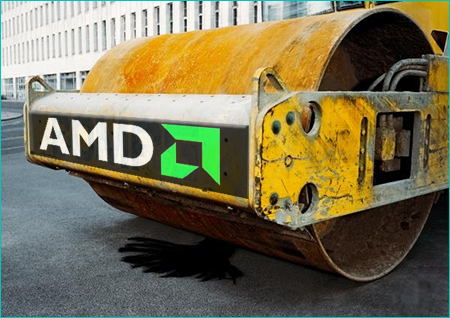
AMD Logo / Steamroller
Enlarge picture
Nobody can radically change a computing architecture and manage to get the first iteration to act exactly as what was initially envisioned. Just like AMD's Barcelona some time ago, many expected it to trample all over Intel’s Core 2 Duo, but in fact it didn’t.

There was nothing catastrophically wrong with the design itself, but not all the bugs were ironed out and the design was not completely optimized.

At the time, Barcelona seemed rushed out, as the company was in a hurry to offer something different than the popular Athlon 64 X2 available in those days.

All that was needed was some grooming in the bug forest and a considerably larger level 3 cache. Then we had Phenom II that was and still is successfully competing against its respective Core 2 Duo counterparts.

The Bulldozer story was similar.

While the design differences between Phenom II and Bulldozer are quite significant and the number of floating point units (FPU) has been halved, many expected the design to literally bulldoze the competition out of the way.

We weren’t so sure about the FlexFP. Our opinion was that it would lead to some serious efficiency and throughput increases in the server sector, but on the desktop side we would have considered AMD lucky if it managed to get 4 FPUs to perform like the previous 6 FPUs.

To its credit, AMD has successfully managed exactly that, but that’s certainly not enough to fight Ivy Bridge.

The incoming Vishera silicon with Piledriver enhancements is what Bulldozer should have been in the first place.

We’re sure AMD’s Dirk Meyer was envisioning something like Steamroller. He should have made the initial Bulldozer more like today’s Piledriver, but at least we know that Bulldozer had some issues that have now been ironed out.

Many say that Steamroller will not be able to face Haswell, but the reality is that Steamroller is apparently a proper implementation of the FlexFP concept. The doubling of the cache, dispatch and fetching units will greatly increase the performance.

Many are estimating conservative values ranging between a 20% and a 30% performance improvement over the current Bulldozer processors, but sources inside the engineering department at AMD are reportedly expecting 45% performance improvements.

This puts AMD’s Steamroller beyond Ivy Bridge’s performance and right against Intel’s Haswell.

Some are wondering about the company’s statements that they won’t be fighting for the desktop market anymore.

We believe that’s just PR talk to divert attention from the fact than AMD’s current top desktop CPUs barely make it against Intel’s quad-cores with no fighting chance against any hexa-core from the CPU giant.

The most pressing question right now is whether AMD’s next desktop platform will keep the current socket or whether they will go for something with DDR4.

It would really be early for the company to go for DDR4, as even Intel is not planning DDR4 platforms until 2014, but it will also seem strange to see AMD change two sockets in two years.

A new Steamroller socket with support for DDR3 will allow AMD to get away from any drawbacks that the current AM3+ platform might have, but then, in 2014 they will be forced to put another socket out with DDR4 support.

One strategy would be to keep the current AM3+ design and use some level 4 cache to improve on the lack of a triple or quad channel memory controller, but that remains to be seen.


10,815 hits · 5 comments
Link to this article · Print article · Send to friend

MUST-READ RELATED ARTICLES:


AMD Experiments with Different CPU Design Methods – Part 2

Russia Building an Android Tablet for the Army

ViewSonic Announces VX70 IPS LED Monitors

T-Mobile Samsung Galaxy Tab 10.1 Gets ICS Update

Philips Launches UltraWide 29” AH-IPS Monitors with MultiView

READER COMMENTS:


Comment #1 by: Jimbo on 07 Sep 2012, 22:21 UTC reply to this comment

This might be true -- I've been seeing a newfound spark in AMD engineers eyes about the future of their desktop CPUs. I think they may well be on to fixing the bulldozer design as it should have been, but let's face it - by the time we actually see Steamroller - Intel will be beyond Haswell so the story then will be similar to now.

Comment #1.1 by: shodo on 20 Nov 2012, 05:05 GMT

You mean you hope Haswell does... Because you do not know and cannot actually know.
Personally I will laugh myself silly while listening to all the intel fanboys cry when they have to shell out hundreds of extra dollars just to have something comparable to AMD.
oh wait , they already do ...

Comment #1.2 by: Bob bryans on 12 Jan 2013, 03:17 GMT

AMD CPU's are acctually better than intel CPU's in the laptop market, with their low voltage APU's creating the world's first gaming netbook and their piledrivers also use the same volts than a intel i7 for an added 4 cores. Why don't we see them on laptops yet?
Simple. Intel uses bribery in the form of cash payments to keep amd out.
If AMD forces its way into the laptop market, we could possibly see and 300-500 dollar difference for the same overall performance.
Add the fact that the graphics core in the APU can sync with the on board discrete graphics, the worlds first and only dual GPU's in computer less than an inch, and you have reason to buy


Comment #2 by: rollyocampo on 12 Sep 2012, 16:40 UTC reply to this comment

It makes sense for a current laggard like AMD to say that it's not battling for the desktop market anymore but if Rory Read has any idea how it is to run a tech company, it is not far-fetched to presume that his marching orders for his engineering team is to work 24/7 to get as near, and as quickly, as possible to competitive performance vis-a-vis Haswell and its successors. Then he can announce that they have near-parity on the desktop even as AMD moves to secure a foothold on the mobile CPU market where its edge on GPU technology may prove to be a compelling advantage.


Comment #3 by: Bob bryans on 12 Jan 2013, 03:09 UTC reply to this comment

if amd really does change a socket when ddr4 comes out, dont blame them. AMD's current socket is already 4-5 years past its Athlon glory days. Its about time AMD does something new. they learned their lesson when they tripe switched in a year back in 2005. When intel did it with their LGA 1156 and 1155 sockets, they kinda just relied on their reputaion to surf them accros to the enthusiasts

Copyright © 2001-2013 Softpedia. Contact/Tip us at

WindowsGamesDriversMacLinuxScriptsMobileHandheldNews

SUBMIT PROGRAM   |   ADVERTISE   |   GET HELP   |   SEND US FEEDBACK   |   RSS FEEDS   |   UPDATE YOUR SOFTWARE   |   ROMANIAN FORUM