
Softpedia
 

NEWS CATEGORIES:


NEWS ARCHIVE >>
SOFTPEDIA REVIEWS >>
MEET THE EDITORS >>
TRENDING TODAY
Home > News > Technology and Gadgets > CPU

April 18th, 2012, 08:51 GMT · By

AMD Racing Against Google to Buy MIPS

SHARE:

Adjust text size:

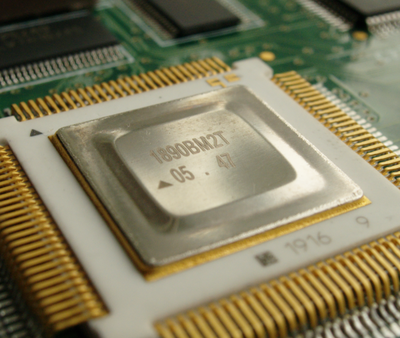
MIPS R3000 compatible processor
Enlarge picture
While some might have never heard of it, MIPS stands for “Microprocessor without Interlocked Pipeline Stages” and is a RISC type of processor architecture, just like AMD’s or Intel’s x86 CPUs are. It is not something radically different and hard to develop and to develop for, like Intel’s Itanium using the company’s failed EPIC architecture.

Having used TSMC to build modularized APUs with separate designs of general purpose processing unit and a graphics processing unit on the same die, AMD said, through the voice of its CEO, Rory Read, that it is thinking about using 3rd party IP next to its own IP into the company’s APUs.

However, due to AMD’s hard financial battles from the last four years, it has also lost a lot of design talent and the Texas-based CPU designer may be looking to get some of its old friends back, and even some new, with the acquisition of California-based MIPS Technologies. 

MIPS is a very popular technology in the processor business. While lately they’ve been a little more discrete, during the 80s and 90s, almost 33% of the RISC processors produced in the entire world (those include AMD and Intel CPUs) were MIPS based.

In 1992, server maker SGI acquires MIPS to secure the supply of MIPS processors for its company’s servers and workstations. Later, in 1998, SGI decided to migrate towards Intel’s Itanium architecture. This was the move that put MIPS out of SGI’s focus and deprived the company’s projects of vital R&D funds.

Subsequently, the Itanium switch also led to SGI’s downfall until they’ve filed for bankruptcy in 2009.

MIPS was completely spun off by SGI in 2000 and became an IP and design company licensing to others the different MIPS instruction sets.

For those who don’t know, many of you have been using MIPS processors without even being aware of it, as many of their designs are used by Broadcom in router chipsets;SONY’s PlayStation Portable has a MIPS processor powering it and the famous PlayStation 2 was built around a MIPS CPU also etc.

MIPS designs are characterized by being very customizable and server suitable. They were used by SGI, one of world’s greatest server makes, for more than a decade and, while ARM’s 64 Bit implementation is still some time away from servers, MIPS 64 Bit server CPU have been around since 1991.

While being very power efficient, MIPS are currently working to build the world’s first $99 Android table, while they already have an Android 4.0 Ice Cream Sandwich available. ARM is the current king of the tablet world but they don’t have a 64 Bit design ready yet.

In short, MIPS already has what ARM has, but also has more than two decades of server experience that ARM is completely lacking.

Back in 2008, MIPS was losing money and the new CEO started streamlining the company and steering it towards a buyout that will ensure the much needed funds for R&D. The company’s numbers dropped from 500 to around 150 during the last 4 years and now MIPS has hired Goldman Sachs to purse the potential buyout.

AMD is already a MIPS 64 Bit licensee, but the Texas CPU manufacturer might also want the engineers that designed the IP.

Some of these guys are not strangers to AMD, as two members of MIPS’ Board of Directors are now Mr. Ravi Krisha and Fred Weber.

Back in the days of K7 and K8, Ravi Krisha was with AMD, building the Iron Gate chipset and Fred Weber worked on K8, the first x86 64 Bit processor.

Sure, AMD might not have the funds to buy MIPS or it might be outbid by the likes of Google, Nvidia or Qualcomm, but right now, the second largest x86 CPU designer in the world would be a perfect buyer for MIPS.

FILED UNDER:
AMD
MIPS
ARM
CPU
server


3,113 hits · 4 comments
Link to this article · Print article · Send to friend

MUST-READ RELATED ARTICLES:


AMD’s New Steamroller Architecture to Bring Significant Performance

AMD Ready to Launch New Opteron Processor Models

Xyratex Intros OneStor 2584

Tyan Announces the Newest Generation of Platforms Supporting the E5-2600 Intel Processor

LSI Launches the Nytro WarpDrive

READER COMMENTS:


Comment #1 by: madooo12 on 20 Apr 2012, 11:25 UTC reply to this comment

"...is a RISC type of processor architecture, just like AMD’s or Intel’s x86 CPUs are."
is x86 RISC? for years I though it was CISC? the conspiracy!

Comment #1.1 by: Constantin Murariu on 25 Apr 2012, 14:44 GMT

Current x86 CPU use a different set of instructions inside the core. There is a translation unit that converts the x86 instruction in RISC-like instructions, they are executed by the CPU and then the result is translated into x86 code. x86 legacy has always been a ball and chain for AMD and Intel. Intel is even more into RISC type of computing ever since they put so much value into the micro-ops concept. It was considered that if Aplha EV6 would have been implemented without the legacy x86 into the K7, the performance would have been considerably higher.


Comment #2 by: PathagenX on 07 May 2012, 09:01 UTC reply to this comment

Intel and AMD make CISC CPUs. Complex Instruction Set Computing. Though I know that Intel has poked and failed at RISC designs, the x86 and AMD equivalent have never been RISC designs.

Comment #2.1 by: Constantin Murariu on 07 May 2012, 09:20 GMT

Many consider modern CPU designs as being RISC like designs and only the x86 support legacy is keeping them from being full blown RISC. Transmeta's CPUs were closer to CISC than x86, but the official characterization of their internal architecture was VLIW although they has nothing to do with the VLIW design of an AMD GPU for example.

I also look at modern x86 designs as being RISC like although a complete characterization can be found here and I completely agree with it :

http://crazyinfotech.blogspot.com/2008/09/risc-vs-cisc-vs-vliw.html

I just rather give more importance to the actual content of the issue rather than the definition.

[quote]By throwing out all the complex instructions, RISC CPU designers could use random logic rather than microcode (by this time, CPU speeds were outpacing memory speeds). Rather than making an individual instruction more complex, they could move the complexity to the system level and add many on-chip features to improve the overall system performance (like caches, pipelines, and other advanced mainframe features of the time). Thus, the great "RISC vs. CISC" debate was born. [/quote]

I simply see this happening now and it's been happening for the last 17 years.

[quote]To achieve this raw performance advantage, the 80x86 has borrowed heavily from RISC research. Intel has divided the instruction set into a set of simple instructions that Intel calls the "RISC core" and the remaining, complex instructions. [/quote]

That's exactly why I consider modern x86 designs as being RISC architectures rather than CISC. The legacy part, in my opinion, is just added to each new architecture launched.

Copyright © 2001-2013 Softpedia. Contact/Tip us at

WindowsGamesDriversMacLinuxScriptsMobileHandheldNews

SUBMIT PROGRAM   |   ADVERTISE   |   GET HELP   |   SEND US FEEDBACK   |   RSS FEEDS   |   UPDATE YOUR SOFTWARE   |   ROMANIAN FORUM