 14 DAY TRIAL //
 We all know that women would do virtually anything to keep up with the trends, from getting on almost impossibly high heels and running to catch a cab to work, to breaking their back by carrying huge bags in which they stuff almost everything they find around the house, just in case they might need it under a special circumstance. Of course, this is what today’s fashion-savvy females do but, as we all know, they were victims of the trends in the past as well. Corsets, heavy gowns and even heavier headdress, below you have three of the most popular fashion trends in history, which also happened to be extremely deadly. More is to follow soon.
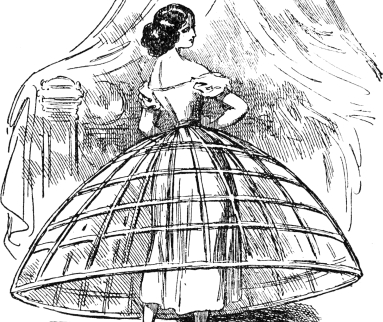
Thanks to the guys over at Cracked, a special chart of the killer trends is now available for us to see exactly just to what lengths women (but men, too) went just to feel socially accepted. The last position on it goes to the crinoline. This item was actually a hoop skirt women in the 19th century were extremely fond of, made of horsehair and threads of steel. It was worn under the regular skirt (or more of them, depending on the occasion and the wearer’s social status), and was meant to make the waist look slimmer and give more oomph to the outfit.
Other than being extremely heavy and making walking almost impossible (then again, most females at the time had nowhere to hurry to, and spent most of their time idly strolling), it was also extremely dangerous. Legend has it that many a woman walking on the piers or cliffs were literally swept away by a stronger gush of wind, thrown into the sea, where they inevitably drowned because the steel cage and the many skirts made it impossible for them to even attempt to fight for their lives.
The crinoline also exposed the woman wearer to risking death by fire, since it required plenty of space for her to move – space that, in some cases, was unavailable, and she brushed her way past a candle or two and her gown caught fire.
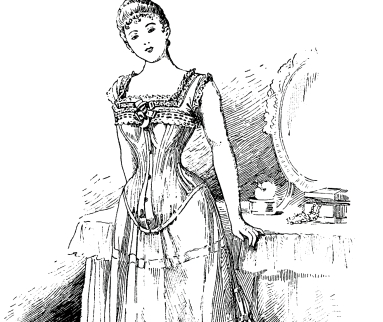
On the second position of killer fashion trends we find the corset, which is still in heavy use today. However, unlike now, back in the days of yore, the corset was not just meant to hide some extra weight around the tummy, as it was tightened to the point of making the woman look like an hourglass. Inevitably, squeezing the body in such a contraption did have its effects, in that the ribs pressed on the lungs and internal organs, which made everything (from walking at a brisker pace to becoming agitated for having received a letter from some distant cousin) impossible.
This is how “the heaving bosom” came into play, where the woman would sit down and breathe in a certain way to make sure that her lungs got enough air. History says that even the very act of breathing had to be done in a certain manner, since, if due caution was not exercised, the corset could instantly kill the wearer by breaking a rib that could, in turn, pierce the lung or another organ. As a matter of fact, in 1903, the case of a woman is documented as dying after a piece of steel from her corset lodged in her heart.
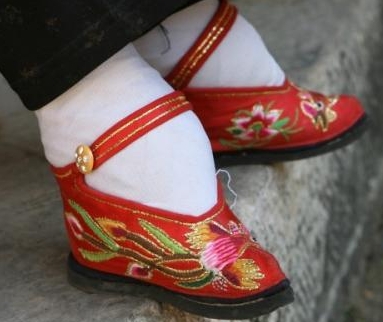
At number one, we have yet another trend that can still be observed today in some parts of the world. Popular from the 8th century until the beginning of the 1900s, footbinding (or “lotus feet”) was not just something that women picked up, did and then forgot about it. Because it implied that the feet have a certain size to fit certain type of shoes, it required preparation ever since early in life, when the girl in question was anywhere from 2 to 7 years old. First off, she was given a special bath (that could be of herbs to urine, depending on the tradition of the family), and her toes, except for the big one, were turned inwards, while the Arch of the foot was bent back. Bandages were applied, which, in time, would become tighter and tighter until the foot lost the shape we know today and was just a continuation of the leg.
The reasoning behind this, it is said, was that a woman’s regular foot was a not too pleasant sight, which made the female herself ugly and less likely to get married. Moreover, a woman with normal feet was seen as “provincial,” because, obviously, only farmers were able to walk properly and not just stagger about. On that note, footbinding was not seen as an inconvenient to women since, as also noted above, they had no place to go. If they happened to die from this (gangrene would often set in, as well as all types of nasty infections), which they often did, then at least they died with beautiful feet – as a side note, men never saw these stumps, as women made sure to always cover them.
Stay tuned here for more killer fashion trends in a following article.