 14 DAY TRIAL //
 Crows and their relatives (ravens, magpies, jays) are considered the most intelligent group of birds. But there is one species that outsmarts them all.
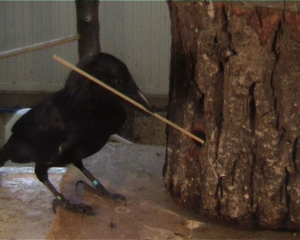
The New Caledonia's crow (New Caledonia is an island located east of Australia), Corvus moneduloides, are able to make tools from twigs and even their own feathers in order to get inaccessible food.
A new study suggests that the propensity for learning to make tools is innate, but the offspring have to watch the adults in order to become truly proficient. Some animals, like Egyptian vulture or mongooses - which brake ostrich egg shells using stones or Galapagos finches that pull out grubs using thorns - use tools, but very few are known as tool makers (e.g. Chimpanzees that make termite "fishing" tool from blades) and this is the only bird known to do that.
But the New Caledonian crow is the only non human species that makes tools from materials it does not encounter in the wild. In their habitats, natural forest environment, the darkened birds turn twigs, leaves and even their own feathers into tools for driving out insects from dead wood. The crows adjust the tool's design to be appropriate for the situation. For example, when a bird wants to get an animal from a small tree hole, it will cut and adjust a branch to the right width to fit into the hole.
Researchers have discovered that in crow populations living in different regions of the island, tool shapes may vary a lot, so the young crows learn to fashion tools in a particular way inside the group. This means that these birds present a tool technology culture, similar to that of humans and chimps.
A team at the University of Oxford hand-raised four New Caledonian crows: two offspring received video lessons about how to use tools from human foster parents, the other two did not. All four juveniles used tools to reach food from crevices, so this ability of using tools is innate. But the schooled birds use the tools more and faster. Thus, the tool use among New Caledonian crows is partly inherited and partly learned. Also, the tool crafting technique of the hand raised crows was crude, compared to that found in wild crows.
These studies could shed light on how tool use evolved in humans. Birds develop much faster than humans or chimps, and experiments on humans would be illegal and not ethical. Not to mention that chimps are quickly disappearing from the wild and thus, performing such experiences on them would put them at high danger.