 14 DAY TRIAL //
 Under the Big Bang theory, the most commonly accepted explanation of how our Universe came to be, the Cosmos appeared some 13.75 billion years ago. Astronomers have now found two alien worlds that are only 900,000 younger than that.
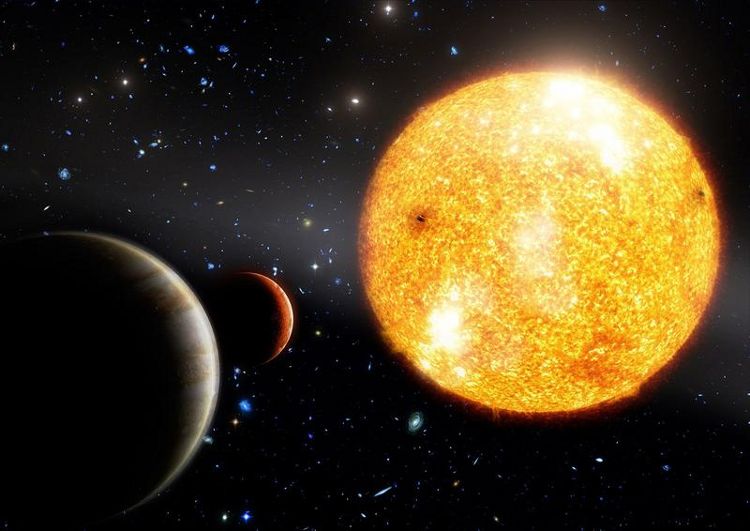
The Jupiter-like gas giants are estimated to be more than 12.8 billion years old. They orbit a star called HIP 11952, which is located in the constellation Cetus, just 375 light-years away from our own planet.
This discovery is very important, primarily because it demonstrates that the early Universe was populated by significantly higher numbers of planets than originally calculated. This data could lead to a better understanding of how the first galaxies and stars evolved.
Scientists believe that these two worlds are the oldest found to date. They are Earth's seniors nearly 3 times over, since our planet is only around 4.5 billion years old. The Sun itself collapsed from its hydrogen cloud some 4.6 billion years ago, Space reports.
Discovering these worlds is just like making an archaeological finding in our backyard, believes Johny Setiawan, who is an astronomer at the Max Planck Institute for Astronomy in Heidelberg, Germany. He was also the leader of the team that found the exoplanets, HIP 11952b and HIP 11952c.
“These planets probably formed when our galaxy itself was still a baby,” the expert adds. Current estimates indicate that the Milky Way is about 10 billion years old. Establishing its age with certainty is very difficult, due to the fact that it underwent several galactic collisions and mergers in the process.
One of the things betraying HIP 11952's age is the fact that it's very metal-poor, displaying only minimal amounts of other elements besides hydrogen and helium. Metal-poor stars are the hallmark of the early Universe, when heavier chemicals had not yet been synthesized.
“In 2010 we found the first example of such a metal-poor system, HIP 13044. Back then, we thought it might be a unique case; now it seems as if there might be more planets around metal-poor stars than expected,” expert Veronica Roccatagliata explains, quoted by Space.
The astronomer, who is based at the University Observatory Munich, in Germany, holds an appointment as the principal investigator for the new planet survey.
“We would like to discover and study more planetary systems of this kind. That would allow us to refine our theories of planet formation. The discovery of the planets of HIP 11952 shows that planets have been forming throughout the life of our Universe,” Heidelberg University expert Anna Pasquali says.